Money
Let’s talk about how hardware devices are made. 1
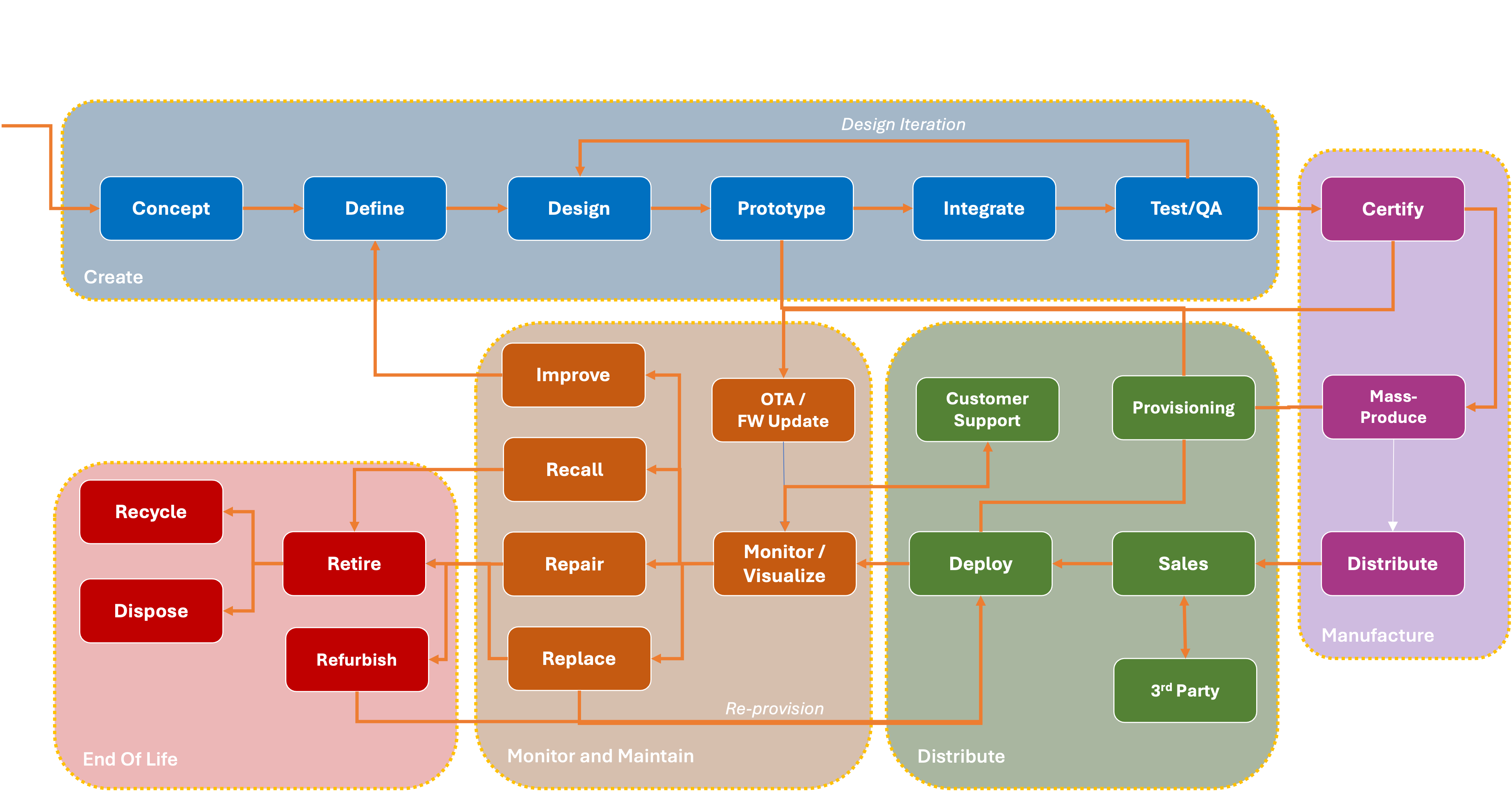
This somewhat simplified diagram captures the many stages of hardware development, each requiring different skill sets, iterations, false starts, failed experiments, unexpected supplier issues, certification delays, late-night overseas calls, material changes, in-person flights, and so much blood, sweat, and tears — each adding delay and cost.
This is why mass-produced hardware development takes a long time.

It would be a miracle if you could go from an original idea to shipping in less than a year (trust me, I’ve tried many times across multiple projects).
This is where Original Design Manufacturing (ODM) (aka white label) products come into play, where a basic design can be customized with minor changes to speed up time-to-market, albeit at the cost of potential copy-cats.

Most original products require some degree of ingenuity in design and implementation, where everything, from the PCB to the enclosure and firmware, is likely custom-made.
Somewhere during the production lifecycle, someone (hopefully) sweated the cost and revenue model for that product.
In the unconnected hardware world, it’s straightforward to calculate the Cost of goods sold (COGS):
- Cost of goods sold (COGS) includes all of the costs and expenses directly related to the production of goods.
- COGS excludes indirect costs such as overhead and sales and marketing.
- COGS is deducted from revenues (sales) in order to calculate gross profit and gross margin. Higher COGS results in lower margins.
- The value of COGS will change depending on the accounting standards used in the calculation.
- COGS differs from operating expenses (OPEX) in that OPEX includes expenditures that are not directly tied to the production of goods or services.
Make sure you set a price that allows you to make a profit on each sale. Basic business 101. Do it right…

Here’s an old, but still relevant video if you want to dive deeper.
In a Connected Device universe, the math gets more… complicated. You have the basic COGS, plus:
- Development
- Connectivity circuitry (Bluetooth, WiFi, Cell, LoRa, etc.)
- Security (certificate management, encryption co-processor, trusted enclave module)
- On-device AI/ML co-processor (optional)
- Mobile app development for provisioning/communications relay/firmware updates
- On-device User Interface for provisioning (i.e., keyboard)
- Server development / API design
- Testing
- FCC/CE/Bluetooth/WiFi/Matter certification
You also have to keep an eye on the OPEX (Operating Expense), which could well end up higher than the COGS:
- Runtime/Operations:
- API processing
- Data bandwidth
- Storage
- Data Analytics
- Ongoing firmware updates
- Cloud AI/ML
- Push notifications
- So much more…
These vary based on how you plan to deploy the server, whether on-premises, in the cloud, serverless, or as a hybrid combination.
Then there are local data sovereignty/privacy regulations. For example, there are different rules depending on whether your product has users in European Union, India, Japan, or China. This means you may have to deploy separate servers and comply with differrent rules for each locality where you plan to sell your equipment.
You know what that means? Yup. Added Cost.
There’s also one constant in all of this: storage will always be growing. Most companies never delete old data.

The amount you charge per device now needs to take into account
There are two ways to recoup these costs:
-
Up-front: set a price that covers ALL your future costs. Calculate the monthly ongoing cost of operations per device. Multiply by how long you think each device will be around. Allow for the dreaded SaaS churn. For example, if each device costs you $5/month and you project the device will be in service for 4 years, that’s: $5 * 12 (months) * 4 = $240. You should make sure you have added at least $240 to the price up-front. If your product is in a price-sensitive category, that’s a heavy ask. Not everyone will keep a device for that long, but some might keep it longer. The logic is a little backward. The sooner someone stops using your device, the higher your margin. For each month your loyal customers continue to use your product after the break-even date, they’re effectively reducing your profit.
-
On-going: This is the dreaded hardware subscription model (more on this later).
Hopefully, you had a financial forecaster on staff way before you started production, so you could game out all the possible outcomes. Believe it or not, there have been large, connected device vendors who didn’t think of this until way too late.

Why does this matter, you may ask? We’re here to talk about chatbots and LLMs?
Ignore at your peril.
Recurring Revenue

One of the most popular schemes to recoup running expenses is to sell a product but have it come with a Subscription. App stores and Games have conditioned users by now. The stats are lucrative.

Connected hardware makers (especially those in the high-end segment) dream of achieving these types of post-sales numbers. However, they have to work on adjusting expectations.

Most experiments were, unsuprisingly, derided, and consumer adoption has not met expectations.

But that has not stopped other domains from trying.

The economics of systems with ongoing expenses dovetail into the realm of Services. Large companies like Amazon, Apple, Google, and Microsoft love services.

Subscriptions allow post-sale revenues not only to cover operating expenses, but also to fund improved functionality (i.e., firmware updates) and product R&D. From a company’s point of view, they make a lot of sense. However, many users dislike it, especially those accustomed to the previous, unconnected hardware model, where you paid for a device once and owned it forever.
When it comes to software-only AI Assistants, subscriptions are a viable path. You download an app and make use of services that require substantial back-end resources.
However, for hardware Assistants, vendors have been reluctant to add fees beyond the original purchase price.

For a large-screen 21” Echo Show model, the $399.99 price may leave some headroom to pay for future operating expenses, but a $50 Echo Dot (frequently discounted) doesn’t leave much of a cushion.

Amazon has reportedly lost $10 billion a year so that they could get Echo devices into as many households as possible. Google does not break out the numbers, but their Google Nest Mini devices are almost certainly selling close to (or below) cost.
Large companies may be willing to absorb ongoing losses to, hoping to make up for it downstream, or by acquiring customer data for training their models. Smaller companies, however, do not have this option, and if their expenses can not be covered by revenues, they will simply go out of business, taking the service back-end with them. This is what in the hardware business is called bricking, and it’s not cool.

Startup device vendors may be tempted to create their own back-end stack, but that requires expensive engineering and operations talent. Some will be tempted to piggyback on services offered by cloud providers, like AWS IoT, Microsoft Azure IoT, or Google IoT Core.
Scratch that…

Point is, the economics of connected hardware have to be carefully thought through.
How can AI Businesses make money?

Only 4?
We can top that. Let’s dive in.
Software Assistants
These are software-only assistants that run either inside a custom mobile app or in a browser. Consider the cost of hardware (phone, tablet, or computer) as a sunk cost (aka CAPEX).
| Method | Description | Reference |
|---|---|---|
| Subscription | monthly / annual | Comparing LLM Subscription Plans |
| Tiered Subscription | Pro vs. Regular vs. Team vs. Enterprise | Compare AI models pricing side by side |
| Advertising | Embedding ads inside chats | Google Places Ads inside AI Chatbots With AI Startups |
| Affiliate Links / | Return results with links that generate affiliate fees | Transforming Search and Advertising with Generative AI |
| Integrated / API | Allow access to LLMs by bringing your own keys | IBM: LLM APIs: Tips for bridging the gap |
| Embedded | Access LLM inside app without providing an API key | Use ChatGPT with Apple Intelligence on iPhone |
| Direct | Pay one-time for an app | Lifetime Deals for AI Apps! |
| Pay-as-you-go / Transactional | Per-token | Breaking Down the Cost of Large Language Models. Also: LLM API Pricing Calculator |
| Tiered Pay-as-you-go | Faster response / more tokens at higher tiers | Cursor: Max Mode |
| E-Commerce | Direct recommendation and shopping | A new solution to monetize AI-powered chat experiences and Walmart Partners With OpenAI to Offer Shopping on ChatGPT |
| Subsidized | Other product pays | Try All the Great AI Models and Tools on HIX AI |
| Hybrid | Some features one model and premium features at another | How to Monetize AI |
| Downstream | Indirect leads to other purchases | Alexa Is in Millions of Households—and Amazon Is Losing Billions |
| Data Monetization | Re-selling accumulated data to others | Intelligence at scale: Data monetization in the age of gen AI |
| MCP Access | Any of the above, inside an extension | Bain: Unlocking Hidden Value: A New Approach to Data Monetization with AI |
| Agentic Transactions | Multi-step: coding, problem-solving, search | AI agents have clear mission, hazy business model |
| Agentic Purchasing | On successful transaction, receive affiliate, finders, or % brokerage fees | The Future of AI In Ecommerce |
OpenAI’s recently announced shopping assistant is clearly looking at monetizing its work in a variety of ways:
“We are going to be experimenting with a whole bunch of different ways that this can work,” says Fry. He didn’t share specific plans, saying that providing high-quality recommendations is OpenAI’s first priority right now, and that the company might try different affiliate revenue models in the future.
OpenAI upgrades ChatGPT search with shopping features:
When ChatGPT users search for products, the chatbot will now offer a few recommendations, present images and reviews for those items, and include direct links to web pages where users can buy the products. OpenAI says users can ask super-specific questions in natural language and receive customized results. To start, OpenAI is experimenting with categories such as fashion, beauty, home goods, and electronics.
Leading to OpenAI looking to become the ultimate intermediary. Buy It In ChatGPT:

ChatGPT simply acts as the user’s AI agent—securely passing information between user and merchant, just like a digital personal shopper would.
Merchants pay a small fee on completed purchases , but the service is free for users, doesn’t affect their prices, and doesn’t influence ChatGPT’s product results.
This is based on OpenAI’s Agentic Commerce Protocol:
“An open standard for programmatic commerce flows between buyers, AI agents, and businesses.”
… ACP supports flexible configurations for any commerce type,
including physical and digital goods, subscriptions, and asynchronous purchases .

The question is, will people trust agents to do their shopping. Last time someone tried it out, it didn’t work out too well.
Amazon was reported to have sold Echo devices at a loss, hoping to recoup the expenses indirectly:
When Amazon launched the Echo smart home devices with its Alexa voice assistant in 2014, it pulled a page from shaving giant Gillette’s classic playbook: sell the razors for a pittance in the hope of making heaps of money on purchases of the refill blades.
A decade later, the payoff for Echo hasn’t arrived. While hundreds of millions of customers have Alexa-enabled devices, the idea that people would spend meaningful amounts of money to buy goods on Amazon by talking to the iconic voice assistant on the underpriced speakers didn’t take off.
In the new Alexa+ service, Amazon is offering back-end services bundled with its lucrative Amazon Prime subscription service. For those without Prime, however, a $19.99 monthly fee will apply. We’ll see if that works better.
Whether consumers will use chatbots to search for products remains to be seen. But placing oneself as a necessary middleman in a commercial transaction and taking a cut is a time-honored (and lucrative) practice.

Hardware Assistants
Hardware assistants offer extended features beyond the phone-based software/app model. For one thing, they are usually left plugged in, so battery drain is not an issue. They also often use the home, school, or work WiFi, so no need for a separate data plan. Unlike a phone-based assistant tied to a single individual, they can offer a shared user experience.
They may support any of the above revenue models, but there are a few others specific to devices:
| Method | Description | Reference |
|---|---|---|
| One-time: Basic | Simple speaker | Wired: Best Budget Speaker |
| One-time: Enhanced | Speaker with features like screen, camera, etc. | Wired: Best Smart Display Speaker |
| One-time: Super-Enhanced | All on-device | On-Device AI: Building Smarter, Faster, And Private Applications |
| Multi-room | Hotel Assistants | Aiello Voice Assistant for Hospitality (AVA) |
| Repeater / Mesh | Assistants distributed around home | Thread SmartHome |
| Device + Subscription | Pay for devices, then monthly/annual subscription | Josh |
| SaaS | Pay for device, get service for free | Siri |
| Embedded | device is inside another device, like a vehicle | Stellantis to launch AI-powered in-car assistant |
| Hardware Subsidized | Cost of hardware covers service cost | Rabbit R1 - Unlimited AI |
| Service Subsidized | Cost of other service covers LLM | Meet the new Alexa - Free with Prime |
| Insurance Subsidized | Paid by insurance company | Implementing large language models in healthcare while balancing control, collaboration, costs, and security |
Other Revenue Models
There are business models that have yet to be explored. These include:
| Method | Description | Reference |
|---|---|---|
| Dynamic Pricing | Adjusted based on demand | Data-driven dynamic pricing |
| Value-based | Benefit provided to the user | Pricing approaches for generative AI applications |
| Outcome Based | Based on outcomes from the solution | AI Is Driving A Shift Towards Outcome-Based Pricing |
| Generative | Relative to content produced | What is Generative AI Pricing? |
| Consulting | Professional Services | Top 10: AI Consulting Companies |
| Infrastructure Sub-Leasing | Usage time on platform | Amazon Bedrock |
No Revenue Models
Believe it or not, not generating substantial revenue is itself a viable business model. This is where devices are sold below cost, in order to gather another benefit.
These can be:
- Collection of Data: used to train AI models. This data is unique to a single vendor and can create competitive advantages.
- Tax advantage: offset losses against profits.
- Market share: offering economies of scale with suppliers.
- Branding: Creating awareness of the company’s name.
- Creating an Eco-system: Creating an on-ramp to other products or services.
- Razor/Blade model: Making money on necessary accessories.
Pricing
When it comes to software (or hardware), there are several ways to price a product and service. Each of these requires measuring the units of transaction and forecasting use. These include:
- One-time purchase: Highly risky (as explained above and below).
- Metered: Pay-as-you-go payment based on usage. The metering unit may vary for each application, based on the ongoing cost of operations. For example, number of tokens, number of interactions, or leveled tiers.
- Prepaid: Where users pay a fixed amount at a discount. Beyond that, excess usage is free. This is also risky because a certain percentage of users will inevitably abuse the system, as Cursor found out.
- Prepaid Metered: Similar to Prepaid except once the amount limit is reached, users are either blocked or switched into a standard Metered model.
- Bulk: A fixed bin of use offered at volume discounts. Once exceeded, it may transition to a higher tier or revert to a Metered model.
- Shared: Like Bulk but shared among multiple users – for example a corporate account.
- Subsidized: Portion or all of the fee paid by another entity.
Most LLM-based services currently offer Prepaid, Prepaid Metered, Bulk, and Shared plans.
Sustainability
As consumers, we often seek the lowest-cost option. However, if a company cannot sustain itself with revenue, it will inevitably go out of business. Consider whether a company’s chosen business model is likely to sustain its continued existence.

By way of example: the Rabbit R1 model ($199 for device + Unlimited AI) set off so many red flags for me at launch. Even if their per-device server/cloud cost were, say, $5/month ($60/year), after 3 years ($180), we would be almost at the break-even point, leaving little room for the cost of hardware ($199 - $180 = $19). If the hardware COGS exceed $19 (highly likely), the company starts to inch towards the red. This assumes their development, manufacturing, and marketing costs haven’t increased in the intervening three years.
They would, of course, monetize their users’ usage data, but even that may not be enough to cover the high cost of manufacturing and support. They may have committed a well-known classic blunder, getting involved in a land war in Asia.
Fortunately for their customers, they have since introduced an intern feature, based on a more sustainable Prepaid or Prepaid Metered model.

The purveyors of many LLMs have realized their starting
These usually cost
Inference costs scale with usage, and the big push for agentic uses creates open-ended demands. Many service providers, like Claude Code, provide a limited amount of initial usage as part of their monthly plans, but any amount over and the costs can add up, anecdotally into the thousands.
Thinking Out of the Box
The world of commerce is filled with diverse and intriguing business models.
- Merchandising: shirts, hats, dolls, towels, vapes, car wraps, air purifiers, NFC keys, onesies.
- Media: Television series and movies featuring AI models. Pop songs, memes, and shorts.
- Product Placement: Taxicabs, sporting goods, coupons (NOTE: we want to limit to things that are direct revenue generators)
- Training: classes and certifications.
- Jobs: Job matching, Resume or Portfolio management, or Employment portals.
- Value-based Pricing: a percentage of the value of the ideas being generated.
- Reselling Excess Capcity: Allowing others to use idle compute capacity.
- Expertise Consulting: Professional services to help create businesses like one’s own.
- Other Assistant Form-Factors: health promoters, caregivers, security guards, soldiers, drones, sex companions.
What happens if we apply them here?


If you do create one of these for an AI Assistant, please make sure to send me one for my collection.
Location, Location, Location
Using physical spaces is another way to both generate revenue and create brand awareness.

Amazon tried this already. Didn’t end up too well.


But who knows, maybe it’ll work out for Coffee + AI.
Really Out of the Box
There are other revenue-generating models. Take Drouput, a comedy streaming channel. It’s found a niche demographic and the subscribers are so passionate about the content, they’ve demanded to pay more for the service, just so it stays in business.
We should all wish to offer a service where customers are beggine to through more hard-earned cash our way.
Engaged, passionate customers are the Gold Standard.
Sex
Come on. Every advance in technology has been pioneered by adult-oriented services. The first online subscription service was claimed by Danni’s Hard Drive circa mid-90s.
You think AI is exempt? How about:
There’s more on the way.


Dark Patterns
[ ENGAGEMENTS AND METRICS ] [ GETTING PEOPLE LOCKED INTO SUBSCRIPTIONS ] [ LINKED ACTIONS ONLY TO GET MORE DATA FROM PEOPLE ] [ UPSELLING ]
[ NONE OF THESE ARE THE “HUMANIST” APPROACH – HOW TO BENEFIT PEOPLE ] [ HOW CAN WE FIX THIS? ]
The Tale of Mecha-Fish
# Memory Bank
Title Photo by Dmitrii E. on Unsplash
-
I made the Connected Device Lifecycle diagram to help explain to clients why making hardware takes so long, and to help development teams and PMs plan ahead. It has been vetted by many active professionals across a wide range of projects. ↩︎