
# True StoryI’m sitting across the dining room table, recounting my meeting earlier in the day.
‘So I slid across the envelope full of cash and the check,’ I said.
‘Mmmhhmm,’ my mother nodded.
‘Then he signed the release.’
I had just come from buying out my contract from the CEO of the agency that held it. The consulting job had been with a company in a regulated industry, and even though I had been the one finding it and doing all the work, I was required to go through an ‘approved’ agency. The agency did literally nothing. Just tacked on a fee on top of my invoice, then wrote me a check.
After a few months of chafing under this arrangement, I had decided to see if I could get out of it and go direct. The client manager had assured me they needed me around for at least another year. I consulted an attorney friend who took a look at the contract and told me it was pretty typical: usurious, but ironclad. One year’s worth of salary if directly hired by client. Could not return and work at the client for a year, in any capacity.
But I had a plan.
Made an appointment with the CEO of the agency (who I had never met). Offices in a pricey part of downtown San Francisco’s financial district. After a bit of intro, I outlined my proposal. I would buy out the contract and go direct. He looked bored. Cited the contract: one year’s salary.
I told him I didn’t think that was fair, that I had been the one finding the job, that I was doing all the work, etc. He shrugged. One year.
I reminded him if I quit, neither one of us would get a fee. Told him to check with the account manager and see if that role was easily replaceable. I knew it had taken the client more than a year to find someone. The CEO stepped outside to talk to someeone. Made me wait a few minutes, then came back.
‘Maybe we can figure something out,’ he said sitting down with a tight, forced smile.
I took out a folded white envelope and slid it across the table along with a release form. He opened it up and his eyes went wide. It was full of $100 bills – worth around 1/3 of a year’s worth of their fees, I knew.
Then he got a cheshire grin.
‘Not enough,’ he replied. But he didn’t push the envelope back.
That was as much cash as I had brought. I asked how much. He named twice as much as in the envelope. I countered. We haggled for a few minutes. Then I took out my checkbook (this was a long time ago – pre-cell phones). Wrote a check, but left the To field blank. I slid it all across the table. He opened his top desk drawer, casually slid the envelope and check out of view, then signed the release form.
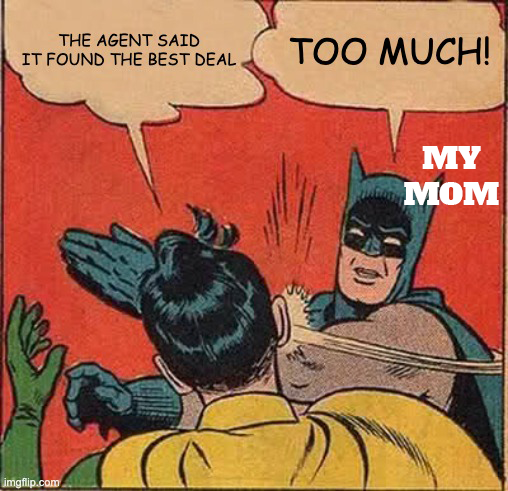
My mother had gotten up to bring over glasses of hot tea on a tray. She stood next to me. Asked how much the check was for. I told her, but hurried to add that I would be making it all back in a few months.
The slap was right upside my head. It didn’t hurt as much as startle.
‘Too much.’
I rubbed the side of my head. It was more of a love-tap, but it felt like a power-slap to the face.
All these years later, I still think of that slap and how I had let down the world fellowship of Camel Traders.
Of course, she had been right.
Agents
Shopping
We have gone from the utopian ideals of AI assistants offering help to those shopping and for a good deal:
With the advent of gen AI agents that assist consumers in their purchasing journeys, we anticipate a shift in the balance of power away from retailers and towards brands and AI-agents. That’s because AI agents will search for consumer goods more broadly, swiftly, and comprehensively than humans. While most consumers shop primarily at a narrow set of retailers—it’s simply too overwhelming to search everywhere, manage an ever growing number of accounts, and evaluate the trustworthiness of every e-commerce retailer—AI agents can do this and optimize on key factors that humans sometimes miss but still value.

The new shiny target for AI firms is to master shopping on behalf of the user. If you’ve followed along the Money Trail I outlined earlier, getting affiliate fees will inevitably be on the business map of most AI companies.
It’s still the early days. News media that have tried it out have returned with less-than-favorable reviews:
Think of OpenAI’s new ChatGPT Agent as a day-one intern who’s incredibly slow at every task but will eventually get the job done.
Well… most of the job. Or… at least part of it. Usually.
…
Our take: It’s a step forward in the world of AI agents, but it’s sluggish, it’s not always reliable, and it can be glitchy.
Google’s already dipped its toes in and thrown in the full AI kitchen sink:
Our new AI Mode experience is built for every part of shopping — from finding inspiration to buying at the right moment. Plus, our virtual try-on tool now works with your own photos.
And if there’s shopping and AI, you can’t leave out Amazon:

From Amazon AGI Labs:
Our dream is for agents to perform wide-ranging, complex, multi-step tasks like organizing a wedding or handling complex IT tasks to increase business productivity. While some use cases are well-suited for today’s technology, multi-step agents prompted with high-level goals still require constant human hovering and supervision.
To address this shortcoming of today’s agents, the Nova Act SDK enables developers to break down complex workflows into reliable atomic commands (e.g., search, checkout, answer questions about the screen). It also enables them to add more detailed instructions to those commands where needed (e.g., “don’t accept the insurance upsell”), call APIs, and even alternate direct browser manipulation through Playwright to further strengthen reliability (e.g., for entering passwords).
One group sure to be benefiting from all this, according to Harvard Business Review:
AI Agent Optimization (AAO) vs. Search-Engine Optimization (SEO)
Taken together, all of this suggests the
potential rise of a new domain—AI agent optimization (AAO) —to help retailers and brands will stand out not just to consumers, but also to AI agents. Just as SEO helps retailers stand out in an e-commerce world, so too will AAO likely become an important future discipline.
There is no way to know if the deals offered by these Agentic systems are really good for the customer or merely ones negotiated by selling and buying agents with misaligned incentives.
# Side NoteCompanies would be well-advised to focus on their customers and their pain-points. Shopping does not strike me as a problem rising to this level.
Maybe AI agents can help winnow down choices when looking for high-ticket items, like healthcare plans, purchasing cars, or negotiating rents.
Then again, perhaps these are activities best handled via personal negotiations.
Roadmap
There’s much work to be done.
- Foundation
- Build an extension architecture around the ROS concept of Nodes, Services, Actions, and Messages. A
- Add the ability to discover and invoke these in nearby Device Groups.
- Add the ability to move between them and adapt gracefully.
- Make sure everything can be simulated and tested in software. This is for both development, training, testing, and CI/CD. ROS Bags is a good starting point.
- Don’t limit yourself to simulating Neurons. There are other abstractions.
- LLMs and statistical generation has value. But it can never match semantics and deep knowledge.
- Go back and start after the Second AI Winter. So much good work was abandoned because the high-falutin’ promises didn’t work out. There are gems there. Read Hofstadter, Minsky, Kant.
- Continue with LLM approach, but also work on semantic understanding. This can be easily rolled out and added by determining domains (show picture)
- Be humble: engage philosophers, artists, musicians, etc. and instead of stealing their material and claiming we won’t be needing them any more, create a pathway for them to be involved and benefit from their expertise.
- Data
- Discriminate between device, application, and user data. The twain shall never meet.
- Encrypt what needs to be encrypted end-to-end.
- Not all data needs to be collected.
- Only collect user data if it directly benefits that user.
- Privacy
- Be careful about side-channels and privacy leakage.
- Things like fingerprinting.
- Run security audits at all levels. Those people should be in the room.
- Humanity
- Replace and you will be hated. Include and you will be loved.
- Mediocrity is not a goal. Provide certainty scores. We don’t need perfection, until we need it.
- Money
- Build a service that people can’t live without.
- Nickel-and-dime to your own peril.
- VC money is not revenue. Only businesses with sustainable profits will survive.
- The strongest revenue is direct, regular cash. The further your business model gets from this the harder to sustain and the more you have to give up.
- On-Device
- Work on putting as much as possible on-device.
- Support switching in and out on-device LLMs, as needed.
- Support on-device caching.
- Support on-device context compression.
- Support on-device mesh. One device inside the network has one context, and another device another. You’re leaving the device, just not the network (which is the unit of privacy).
- Follow the money. The more you run on-device, the lower your operating costs.
- Omnipresent
- Be available at all times. Humans move about. If your functionality is limited to a given location, and not at any other time, you are of no use.
- That’s why people are so attached to cell phones. They can rely on them when they go places. When they didn’t let them work on airplanes, it limited their adoption and use.
- Look at satellite internet connections. They allow people’s devices to keep working. That’s their primary value.
Benefits
- What can provide the biggest benefit to users:
- Companionship
- Agents aren’t multi-step request/response. They are truly AGENTS that work on our behalf. We tell them what we’re interested in and they keep an eye out for those events.
- Keep away distractions, like a valet or secretary.
- Always consider to whom the benefit accrues.
- Assurance
- Know when something isn’t working or is going to be an anomaly. At hardware, network, software, application, and user level.
- Privacy
- Don’t be a tracking device. Bend over backward to prove it.
- Use end-to-end encryption. Any entity that wants to access this trusted data has to ask us.
-
Save money. Always provide an estimate of cost. Nobody likes suprise bills.
- Warnings
- Hubris
- Forget AGI. It’s bullshit.
- 80/20 (Pareto Principle)
- Ignore Semantics and Stick with Statistics.
- Make a prediction on when.
[ Humble song ]
- Be inclusive: by humble. Include everyone.
- Finally
- Tell a story. Narratives are strong. Create an emotional bond between the human and the machine.
Title Photo by Chris Henry on Unsplash