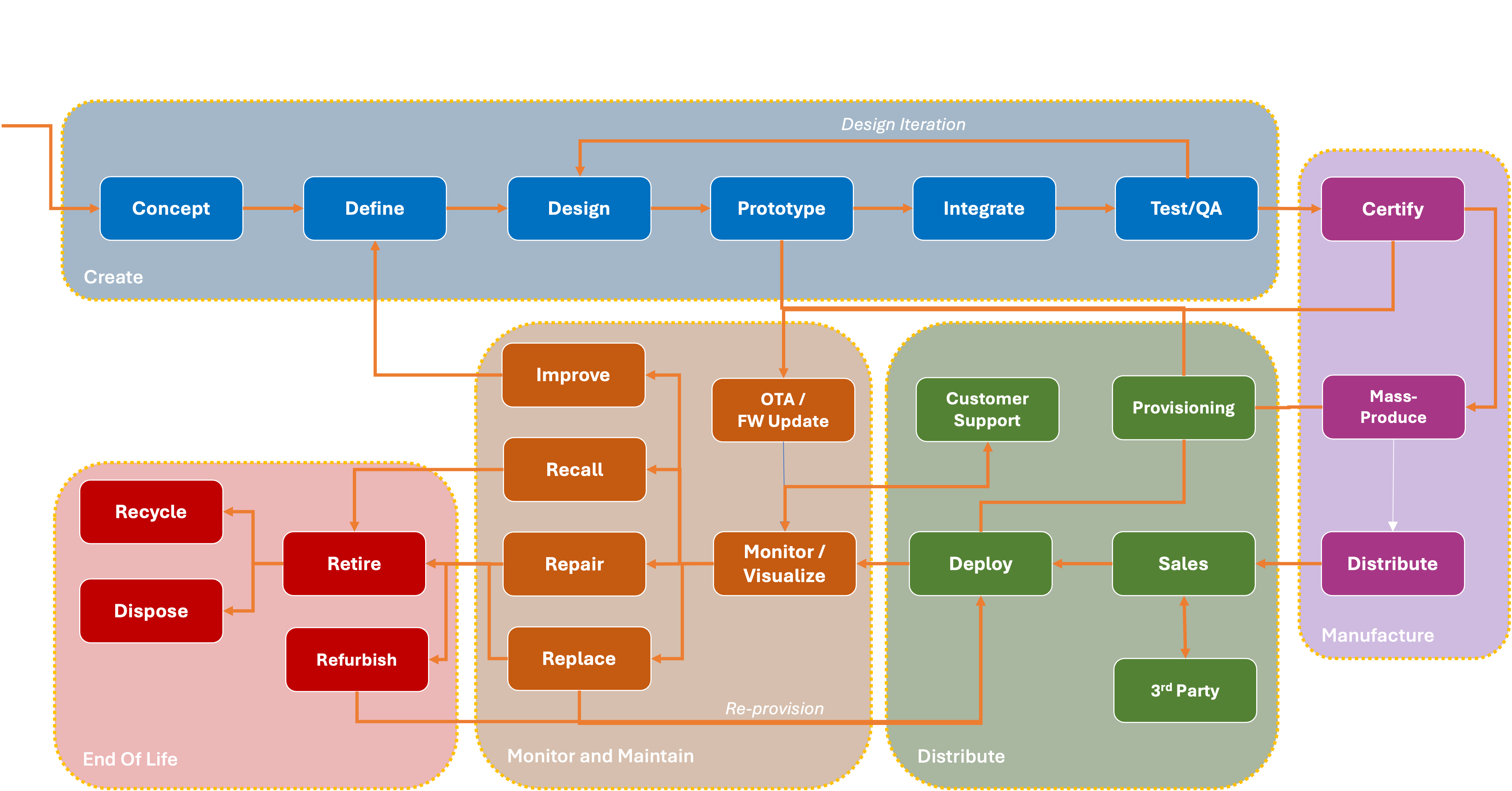
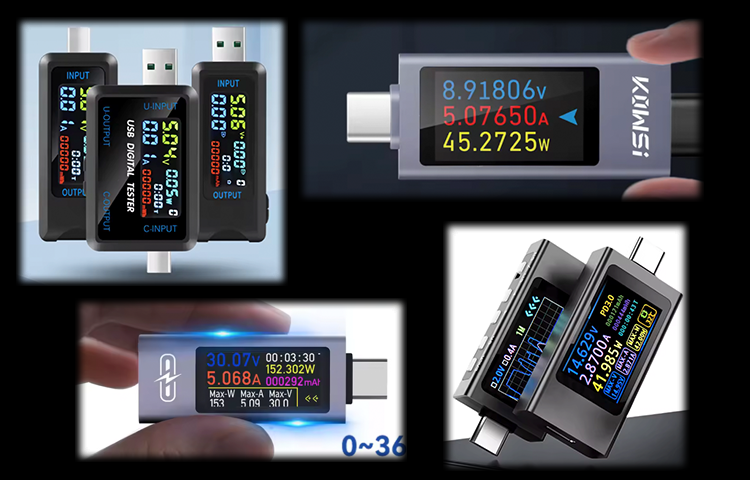
This somewhat simplified diagram captures the many stages of hardware development, each requiring different skill sets, iterations, false starts, failed experiments, unexpected supplier issues, certification delays, late-night overseas calls, material changes, in-person flights, and so much blood, sweat, and tears — each adding delay and cost.
This is why mass-produced hardware development takes a long time.
It would be a miracle if you could go from an original idea to shipping in less than a year (trust me, I’ve tried many times across multiple projects).
This is where Original Design Manufacturing (ODM) (aka white label) products come into play, where a basic design can be customized with minor changes to speed up time-to-market, albeit at the cost of potential copy-cats.
Most original products require some degree of ingenuity in design and implementation, where everything, from the PCB to the enclosure and firmware, is likely custom-made.
Somewhere during the production lifecycle, someone (hopefully) sweated the cost and revenue model for that product.
Mobile app development for provisioning/communications relay/firmware updates
On-device User Interface for provisioning (i.e., keyboard)
Server development / API design
Testing
FCC/CE/Bluetooth/WiFi/Matter certification
You also have to keep an eye on the OPEX (Operating Expense), which could well end up higher than the COGS:
Runtime/Operations:
API processing
Data bandwidth
Storage
Data Analytics
Ongoing firmware updates
Cloud AI/ML
Push notifications
So much more…
These vary based on how you plan to deploy the server, whether on-premises, in the cloud, serverless, or as a hybrid combination.
Then there are local data sovereignty/privacy regulations. For example, there are different rules depending on whether your product has users in European Union, India, Japan, or China. This means you may have to deploy separate servers and comply with differrent rules for each locality where you plan to sell your equipment.
You know what that means? Yup. Added Cost.
There’s also one constant in all of this: storage will always be growing. Most companies never delete old data.
All these costs scale up with every device you sell!
The amount you charge per device now needs to take into account future, indeterminate operational costs . You will need a fairly comprehensive spreadsheet to calculate COGS and the Ongoing Cost of Operations. This isn’t just business overhead. It’s how much post-sale expense you will incur to keep your products working and customers happy.
There are two ways to recoup these costs:
Up-front: set a price that covers ALL your future costs. Calculate the monthly ongoing cost of operations per device. Multiply by how long you think each device will be around. Allow for the dreaded SaaS churn. For example, if each device costs you $5/month and you project the device will be in service for 4 years, that’s: $5 * 12 (months) * 4 = $240. You should make sure you have added at least $240 to the price up-front. If your product is in a price-sensitive category, that’s a heavy ask. Not everyone will keep a device for that long, but some might keep it longer. The logic is a little backward. The sooner someone stops using your device, the higher your margin. For each month your loyal customers continue to use your product after the break-even date, they’re effectively reducing your profit.
On-going: This is the dreaded hardware subscription model (more on this later).
Hopefully, you had a financial forecaster on staff way before you started production, so you could game out all the possible outcomes. Believe it or not, there have been large, connected device vendors who didn’t think of this until way too late.
Why does this matter, you may ask? We’re here to talk about chatbots and LLMs?
Because Hardware AI assistants/companions are a form of connected device.
Ignore at your peril.
Recurring Revenue
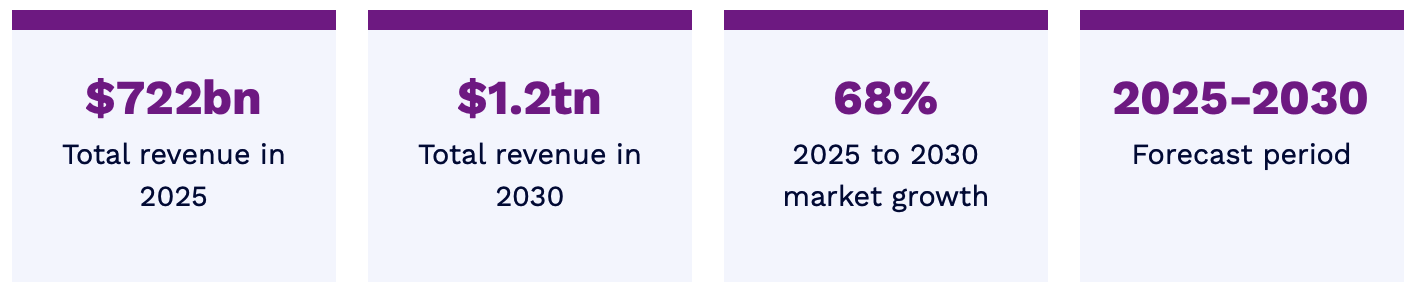
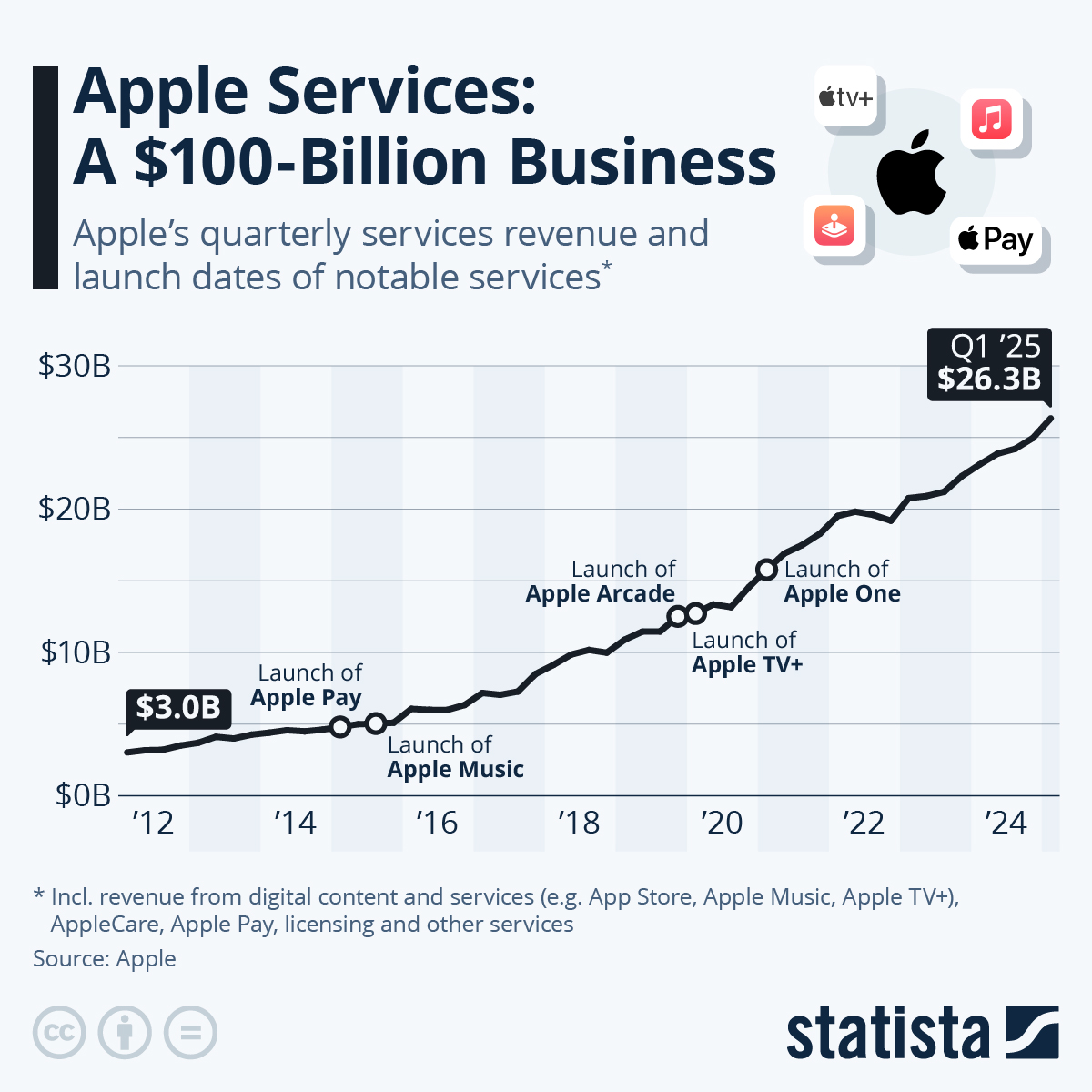
One of the most popular schemes to recoup running expenses is to sell a product but have it come with a Subscription. App stores and Games have conditioned users by now. The stats are lucrative.
Connected hardware makers (especially those in the high-end segment) dream of achieving these types of post-sales numbers. However, they have to work on adjusting expectations.
The economics of systems with ongoing expenses dovetail into the realm of Services. Large companies like Amazon, Apple, Google, and Microsoft love services.
Subscriptions allow post-sale revenues not only to cover operating expenses, but also to fund improved functionality (i.e., firmware updates) and product R&D. From a company’s point of view, they make a lot of sense. However, many users dislike it, especially those accustomed to the previous, unconnected hardware model, where you paid for a device once and owned it forever.
When it comes to software-only AI Assistants, subscriptions are a viable path. You download an app and make use of services that require substantial back-end resources.
However, for hardware Assistants, vendors have been reluctant to add fees beyond the original purchase price.
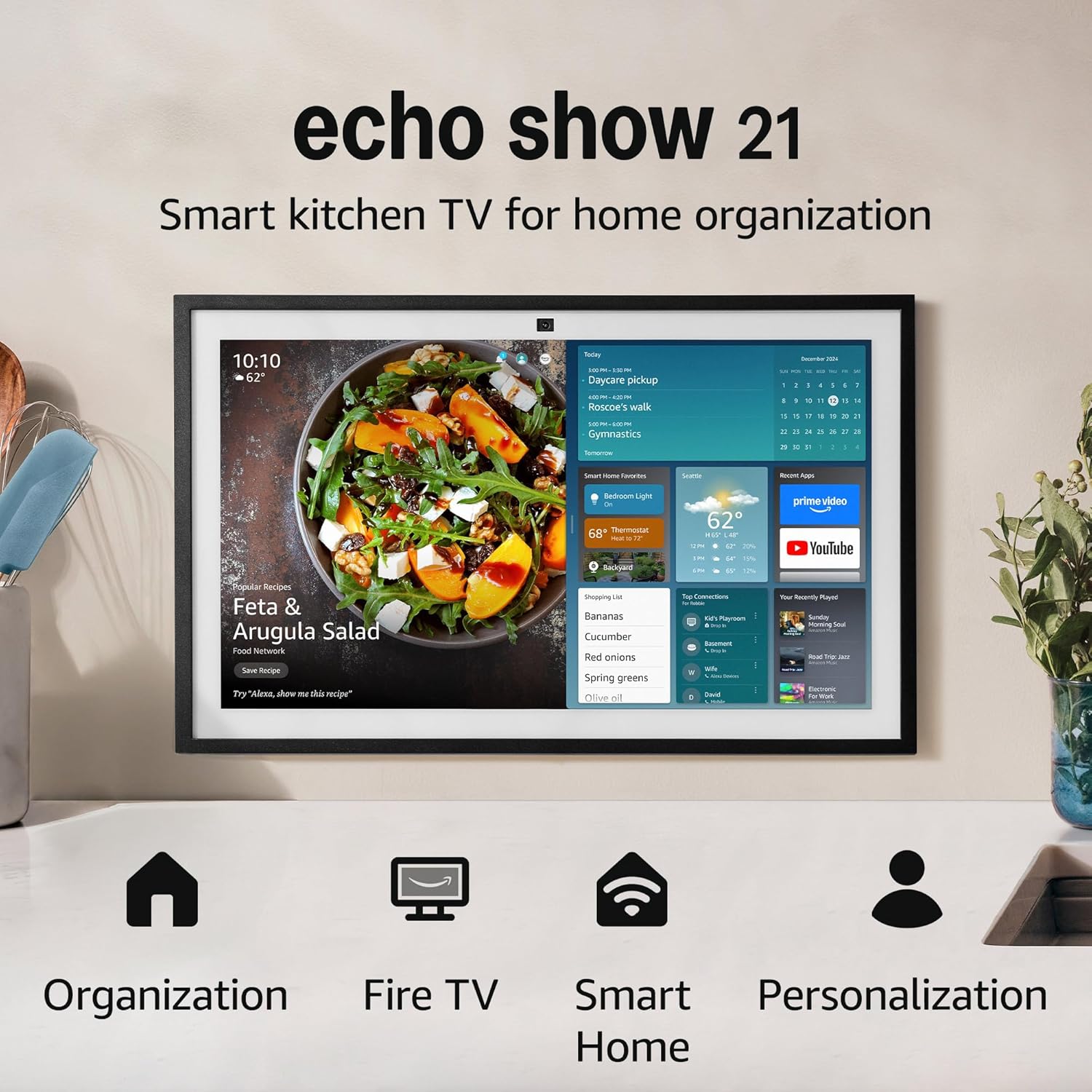
For a large-screen 21” Echo Show model, the $399.99 price may leave some headroom to pay for future operating expenses, but a $50 Echo Dot (frequently discounted) doesn’t leave much of a cushion.
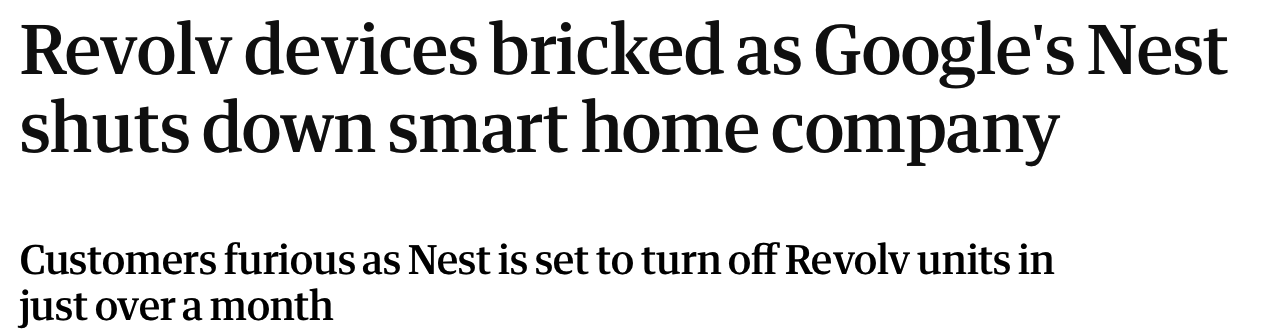
Large companies may be willing to absorb ongoing losses to, hoping to make up for it downstream, or by acquiring customer data for training their models. Smaller companies, however, do not have this option, and if their expenses can not be covered by revenues, they will simply go out of business, taking the service back-end with them. This is what in the hardware business is called bricking, and it’s not cool.
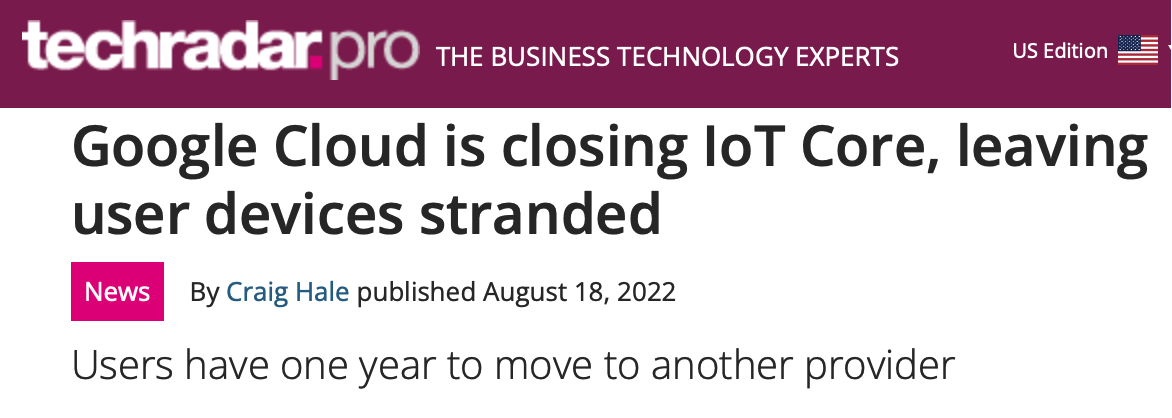
Startup device vendors may be tempted to create their own back-end stack, but that requires expensive engineering and operations talent. Some will be tempted to piggyback on services offered by cloud providers, like AWS IoT, Microsoft Azure IoT, or Google IoT Core.
Point is, the economics of connected hardware have to be carefully thought through. When creating a hardware-based AI Assistant, the revenue model is key. With the advent of next-generation AI Assistants with LLM support, the stakes (and expenses) will be higher.
These are software-only assistants that run either inside a custom mobile app or in a browser. Consider the cost of hardware (phone, tablet, or computer) as a sunk cost (aka CAPEX).
“We are going to be experimenting with a whole bunch of different ways that this can work,” says Fry. He didn’t share specific plans, saying that providing high-quality recommendations is OpenAI’s first priority right now, and that the company might try different affiliate revenue models in the future.
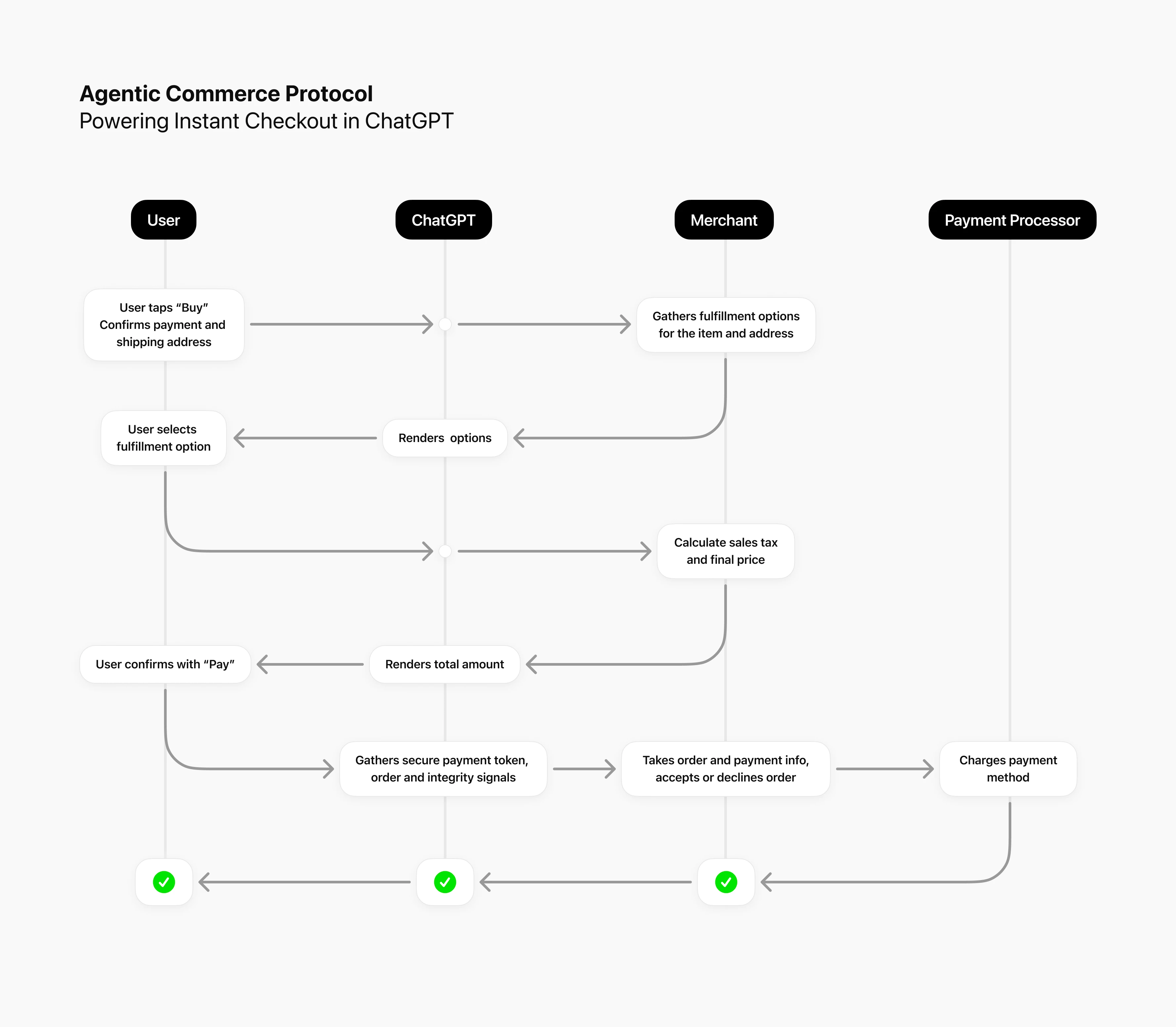
When ChatGPT users search for products, the chatbot will now offer a few recommendations, present images and reviews for those items, and include direct links to web pages where users can buy the products. OpenAI says users can ask super-specific questions in natural language and receive customized results. To start, OpenAI is experimenting with categories such as fashion, beauty, home goods, and electronics.
Leading to OpenAI looking to become the ultimate intermediary. Buy It In ChatGPT:
The question is, will people trust agents to do their shopping. Last time someone tried it out, it didn’t work out too well.
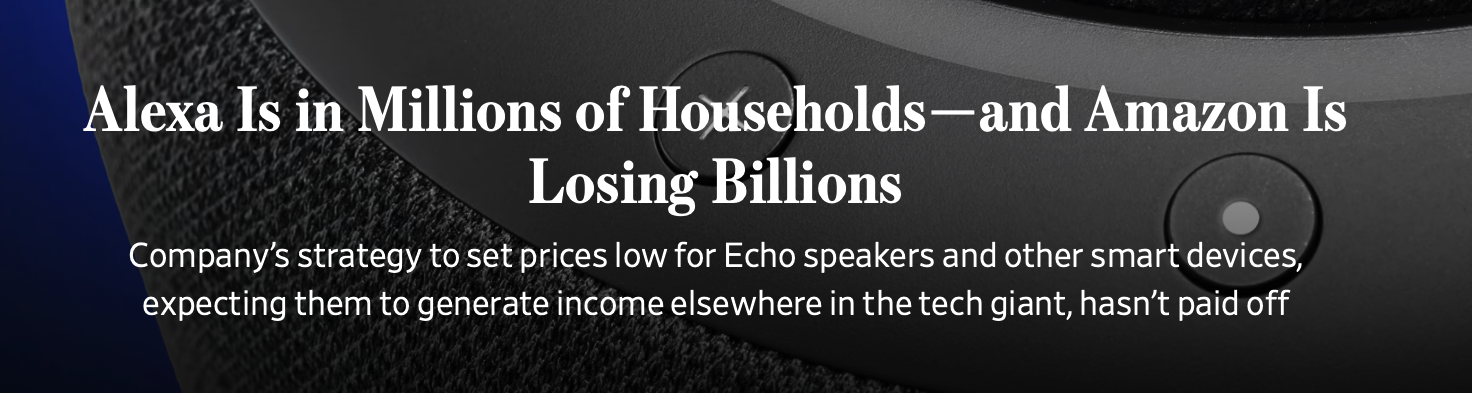
Amazon was reported to have sold Echo devices at a loss, hoping to recoup the expenses indirectly:
When Amazon launched the Echo smart home devices with its Alexa voice assistant in 2014, it pulled a page from shaving giant Gillette’s classic playbook: sell the razors for a pittance in the hope of making heaps of money on purchases of the refill blades.
A decade later, the payoff for Echo hasn’t arrived. While hundreds of millions of customers have Alexa-enabled devices, the idea that people would spend meaningful amounts of money to buy goods on Amazon by talking to the iconic voice assistant on the underpriced speakers didn’t take off.
In the new Alexa+ service, Amazon is offering back-end services bundled with its lucrative Amazon Prime subscription service. For those without Prime, however, a $19.99 monthly fee will apply. We’ll see if that works better.
Whether consumers will use chatbots to search for products remains to be seen. But placing oneself as a necessary middleman in a commercial transaction and taking a cut is a time-honored (and lucrative) practice.
Hardware Assistants
Hardware assistants offer extended features beyond the phone-based software/app model. For one thing, they are usually left plugged in, so battery drain is not an issue. They also often use the home, school, or work WiFi, so no need for a separate data plan. Unlike a phone-based assistant tied to a single individual, they can offer a shared user experience.
They may support any of the above revenue models, but there are a few others specific to devices:
Believe it or not, not generating substantial revenue is itself a viable business model. This is where devices are sold below cost, in order to gather another benefit.
These can be:
Collection of Data: used to train AI models. This data is unique to a single vendor and can create competitive advantages.
Tax advantage: offset losses against profits.
Market share: offering economies of scale with suppliers.
Branding: Creating awareness of the company’s name.
Creating an Eco-system: Creating an on-ramp to other products or services.
Razor/Blade model: Making money on necessary accessories.
Pricing
When it comes to software (or hardware), there are several ways to price a product and service. Each of these requires measuring the units of transaction and forecasting use. These include:
One-time purchase: Highly risky (as explained above and below).
Metered: Pay-as-you-go payment based on usage. The metering unit may vary for each application, based on the ongoing cost of operations. For example, number of tokens, number of interactions, or leveled tiers.
Prepaid: Where users pay a fixed amount at a discount. Beyond that, excess usage is free. This is also risky because a certain percentage of users will inevitably abuse the system, as Cursor found out.
Prepaid Metered: Similar to Prepaid except once the amount limit is reached, users are either blocked or switched into a standard Metered model.
Bulk: A fixed bin of use offered at volume discounts. Once exceeded, it may transition to a higher tier or revert to a Metered model.
Shared: Like Bulk but shared among multiple users – for example a corporate account.
Subsidized: Portion or all of the fee paid by another entity.
Most LLM-based services currently offer Prepaid, Prepaid Metered, Bulk, and Shared plans.
Sustainability
As consumers, we often seek the lowest-cost option. However, if a company cannot sustain itself with revenue, it will inevitably go out of business. Consider whether a company’s chosen business model is likely to sustain its continued existence.
One-time purchase (aka Lifetime) models have fallen out of favor for both software and hardware. These do not account for increasing future costs and almost inevitably lead to unhappiness.
By way of example: the Rabbit R1 model ($199 for device + Unlimited AI) set off so many red flags for me at launch. Even if their per-device server/cloud cost were, say, $5/month ($60/year), after 3 years ($180), we would be almost at the break-even point, leaving little room for the cost of hardware ($199 - $180 = $19). If the hardware COGS exceed $19 (highly likely), the company starts to inch towards the red. This assumes their development, manufacturing, and marketing costs haven’t increased in the intervening three years.
They would, of course, monetize their users’ usage data, but even that may not be enough to cover the high cost of manufacturing and support. They may have committed a well-known classic blunder, getting involved in a land war in Asia.
Fortunately for their customers, they have since introduced an intern feature, based on a more sustainable Prepaid or Prepaid Metered model.
The purveyors of many LLMs have realized their starting $20/month fee is not enough to cover their high training and deployment costs. They are now experimenting with new revenue models like Tiered Subscription (see above) plans, like:
These usually cost $200-250/month and are targeted at pro-sumers. Enterprise or Team rates will likely be negotiated on a case-by-case basis.
Inference costs scale with usage, and the big push for agentic uses creates open-ended demands. Many service providers, like Claude Code, provide a limited amount of initial usage as part of their monthly plans, but any amount over and the costs can add up, anecdotally into the thousands.
Thinking Out of the Box
The world of commerce is filled with diverse and intriguing business models.
Merchandising: shirts, hats, dolls, towels, vapes, car wraps, air purifiers, NFC keys, onesies.
Media: Television series and movies featuring AI models. Pop songs, memes, and shorts.
Product Placement: Taxicabs, sporting goods, coupons (NOTE: we want to limit to things that are direct revenue generators)
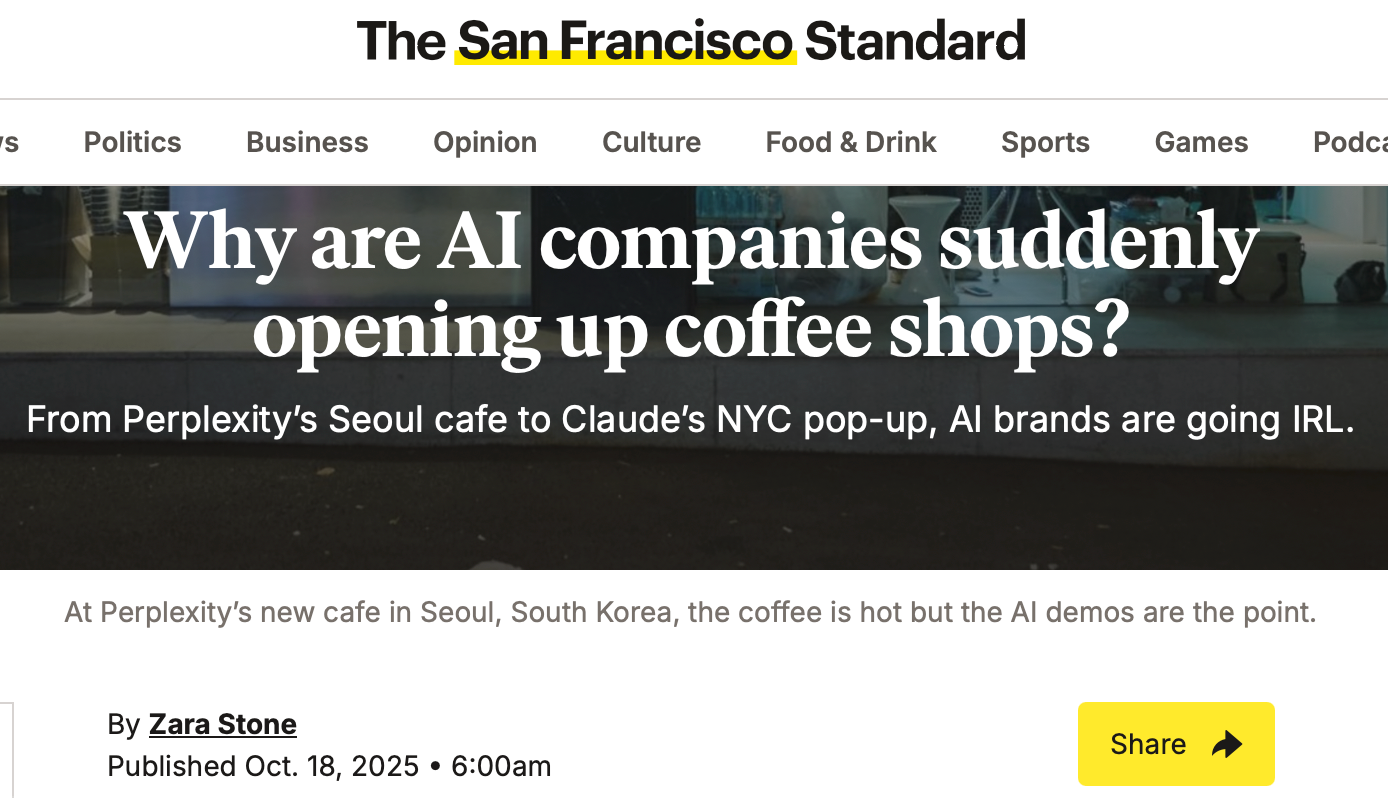
But who knows, maybe it’ll work out for Coffee + AI.
Really Out of the Box
There are other revenue-generating models. Take Drouput, a comedy streaming channel. It’s found a niche demographic and the subscribers are so passionate about the content, they’ve demanded to pay more for the service, just so it stays in business.
We should all wish to offer a service where customers are beggine to through more hard-earned cash our way.
Engaged, passionate customers are the Gold Standard.
Sex
Come on. Every advance in technology has been pioneered by adult-oriented services. The first online subscription service was claimed by Danni’s Hard Drive circa mid-90s.
In the early 90s, I was working on theatrical productions that combined storytelling and opera with technology. These were large spectacles designed by George Coates and staged at a dedicated space he called Performance Works near Civic Center in San Francisco. Almost everyone was a creative, an art enthusiast, with a few of us having access to state-of-the-art graphics and processing tech. It was a fantastic confluence of art and technology, and at the time, it got a lot of attention.
During the week, there would be show rehearsals, but there would also be space for visiting technologists to come and give show-and-tell presentations.
One evening, a group backed by SoftBank Japan was visiting. Each group was showing what they had been working on. Lots of cool stuff. Then a presenter got up and showed a package of what looked like tall seed packages, but with pictures of fish.
He explained that in many large cities, owning a pet as an apartment dweller was not practical. Their product was a digital aquarium that ran on a computer, especially the popular Macintosh computers. It featured very nicely rendered 3D graphics and was one of the showcases for an early version of Macromedia Director, its Lingo programming language, and its Xtras extension system.
What made the app different was that the fish had to be fed and cared for regularly; otherwise, they would die. This was very similar to the extremely popular Tamagotchi craze, but I can’t remember which one came first. The seed packets we were shown were extra ‘fish stock’ you could purchase at local pet shops. They had beautiful, glossy packaging, right down to the Latin names of the fish and detailed care instructions.
This was one of the first cases of for-pay add-ons I had ever encountered. It was brilliant! People would go to the pet shop, look for an electronic fish, purchase it, then take it home. Inside each package was a 3.5-inch floppy disk. It contained a Macromedia Xtra extension with a one-time-use serial number. The Xtra contained media images, code, and other content that was added to the main app. You now have X number of this type of fish available. Every day, you would have to clean the tank, add food (also available for purchase at the pet shop), or decorations like treasure chests, algae, and plastic scuba divers, etc.
They said the app and its add-ons were among the highest-rated programs in all of Japan, and it wasn’t hard to believe them. We were all amazed at how clever it all was. They had worked out the idea, the execution, and the business model. They were visiting Silicon Valley to find partners to bring the technology to the U.S.
At the end of the presentation, a Q&A session followed. I asked them what was next since the concept all worked out so well. The head person smiled, then went over to his briefcase and took out one of the ‘seed packages.’
He said this was something that had not been released yet, but would be shortly after they got back to Japan. It was a Cyberpunk-style Anime Robotic fish.
The Mecha-Fish looked friendly enough, but it had a grungy, rusty look about it, with rivets all around. It was also the only disk that came with just one fish instead of many. I asked why.
‘Because once you put it in the water, it goes around eating all the other fish in the aquarium.’
‘You mean,’ I said, ‘People will be paying you to go destroy all their investments in other fish?’
He nodded.
‘And they have to come back and buy more fish?’
He nodded.
‘But wouldn’t the Mecha-Fish destroy those as well?’
He nodded.
‘So you have to destroy the Mecha-Fish,’ I went on, ‘Which you also paid for…’
I was slow on the uptake.
He nodded and bowed, grinning.
To this day, that story has been my example of one of the most brilliant (but obviously devious) business models I have ever seen…
Not the real Mecha-Fish -- Generated by ChatGPT based on my rough memory.
Until I came across Agentic AI and how it burned through your Pre-paid Metered tokens… to correct ITS OWN errors.
I made the Connected Device Lifecycle diagram to help explain to clients why making hardware takes so long, and to help development teams and PMs plan ahead. It has been vetted by many active professionals across a wide range of projects. ↩︎